You’ve invested in nice landscaping, but your yard doesn’t feel cohesive. The trees block views in weird places, there’s no focal point at night, and that spot where water pools after rain stays muddy for days.
Most homeowners tackle these issues one at a time—hire someone for tree trimming, then months later call another company for lighting. By then, you’ve spent more than you needed and the results don’t work together. The lighting doesn’t highlight the right trees. The water feature gets hidden by overgrowth. Nothing feels intentional.
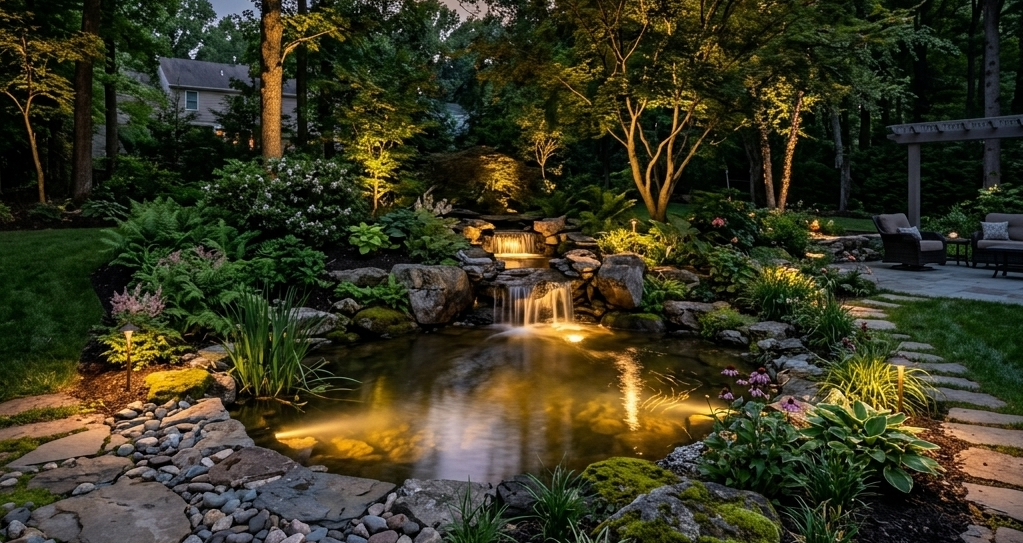
Proper outdoor design brings water, lighting, and trees together as one system. When planned together, these three elements transform yards from “nice enough” to spaces you actually want to spend time in.
This guide shows you how professional water, lighting, and tree services work together—and what to look for when hiring in Harford County.
Why Water, Lighting, and Trees Work as a System (Not Separate Projects)
These three elements depend on each other. Trees provide shade and structure for water features. Lighting makes both visible after dark. Handle them separately and you’ll end up redoing work.
The Real Cost of Piecemeal Projects
I’ve seen it happen dozens of times. A homeowner in Bel Air installs a beautiful koi pond in May, then realizes by October that the maple tree drops debris in it all fall. They spend weekends skimming leaves instead of enjoying the water.
Or someone adds landscape lighting, then decides the overgrown oak needs pruning six months later. Now the fixtures point at bare branches instead of highlighting the house. You either live with it or pay to move lights you just installed.
The worst is when tree work happens after lighting installation. Digging around roots or grinding stumps tears up underground wiring. Now you’re calling the electrician back to repair lines that shouldn’t have been there in the first place.
Companies that handle water, lighting, and tree services coordinate the work so nothing gets torn up twice. You spend less overall and get results that actually make sense together.
How These Services Actually Connect on Your Property
Tree canopy placement affects where you can put sun-loving versus shade-tolerant plantings around water features. A pond surrounded by full-sun perennials won’t thrive under a dense oak canopy.
Root zones determine where you can safely dig for pond installation or trench for lighting wire. Silver maples and willows send roots 30-40 feet from the trunk. Dig into those and you’ve damaged the tree.
Light placement depends entirely on what you’re illuminating. Specimen trees, water features, and pathways all need different fixture types and angles. You can’t plan lighting until you know which trees stay and which go.
There’s also seasonal timing. Tree services often happen in fall and winter when trees are dormant. Water features and lighting typically install in spring and summer. But the planning needs to happen together, months before any digging starts.
Water Features That Make Sense in Maryland’s Climate
Not every water feature works in Harford County. You need designs that handle our freeze-thaw cycles, summer humidity, and the leaves that fall from September through November.
Ponds and Water Gardens
A typical residential pond in Harford County runs 6’x8′ on the small end to 15’x20′ for larger properties. Size matters less than depth when winter comes.
If you want koi or goldfish to survive Maryland winters, you need minimum 18-24 inches of depth. Fish go dormant at the bottom when surface ice forms. Shallow ponds freeze solid and kill everything.
Filtration systems here need to handle leaf debris. A basic skimmer and biological filter work for small ponds. Larger installations need bottom drains and settlement chambers. Otherwise you’re pulling out decomposing leaves by hand every week in fall.
Position ponds near trees for dappled shade, not directly underneath. Full sun in July turns water into algae soup. Dense shade means you can’t grow water lilies or lotus. Dappled afternoon shade from a nearby oak is perfect.
Cost reality: $5,000-$15,000 for an installed koi pond depending on size, filtration, and stone work. That includes excavation, liner, pump, filter, and basic landscaping around the edges.
Waterfalls and Streams
Maryland properties look best with naturalistic waterfall designs using local stone. Formal geometric features rarely match our regional architecture.
Recirculating systems pump water from a lower pond back to the top. A typical residential waterfall uses 2,000-4,000 gallons per hour. The pump runs continuously during the season, adding about $30-50 monthly to your electric bill.
Stone selection matters. Pennsylvania fieldstone and local moss rock look native to Harford County. Imported lava rock or white marble looks transported from somewhere else.
Plan for electrical from the start. Waterfalls need dedicated 20-amp circuits run underground to the pump location. Code requires GFCI protection and proper burial depth (18 inches minimum in Maryland).
Here’s something most contractors won’t tell you: Waterfalls can actually solve drainage problems. That spot where water pools after rain? Excavate it for your lower pond and grade everything toward it. Now the problem area becomes the feature.
Fountains and Bubblers
Fountains work great for smaller yards or formal garden spaces where a naturalistic pond would look out of place. A bubbling urn or millstone fountain needs just 6-8 square feet.
Every fountain in Maryland requires winterization by early November. Water left in pipes and pump housings freezes and cracks. Drain everything, pull the pump, and store it in your basement until spring.
Algae control becomes critical during humid Maryland summers. Fountains have less water volume than ponds, so algae blooms happen faster. Plan on adding bacterial treatments every two weeks and doing a full cleaning monthly.
Lighting integration works two ways. Underwater LEDs sit in the basin pointing up through the water. External spotlights highlight the fountain from 6-8 feet away. Both create completely different nighttime effects.
What Doesn’t Work Here
Skip shallow decorative pools unless you drain them every winter. Ice expansion will crack concrete basins and pop tile loose.
Non-native aquatic plants that won’t survive our winters are a waste of money. Tropical water lilies and papyrus die at first frost. Stick with hardy varieties rated to Zone 6.
Never position water features under sweet gum or pin oak trees. Sweet gum drops spiky seed balls all winter. Pin oaks hold dead leaves until spring. You’ll spend more time cleaning than enjoying the water.
Landscape Lighting That Actually Gets Used
Most landscape lighting sits unused after installation because homeowners don’t want the electric bill or it’s too bright. Good systems are zoned, automated, and designed around how you actually use your yard.
The Three Zones of Outdoor Lighting
Security and safety lighting covers pathways, steps, and driveway edges. These fixtures should turn on automatically at dusk and stay on until dawn. You’re preventing twisted ankles and making it clear where to walk.
Use low-voltage LED path lights spaced 8-10 feet apart along walks. Step lights get recessed into risers or adjacent walls. The goal is subtle illumination that shows edges without flooding the area with light.
Accent lighting highlights specimen trees, water features, and architectural details. These fixtures typically run on a separate zone from security lights so you can control them independently.
Bullet spotlights and well lights positioned 6-10 feet from the subject, aimed upward, create the most dramatic effects. A 3-watt LED can light a 20-foot oak when positioned correctly.
Entertainment lighting covers patios, outdoor kitchens, and seating areas. Put these on manual switches or smart controls. You want them when hosting dinner, not every night when you’re watching TV inside.
String lights, post caps, and wall sconces work here. Make everything dimmable so you can adjust for ambiance. Nobody wants to eat under lights that feel like a grocery store parking lot.
LED vs. Traditional (And Why It Matters for Your Electric Bill)
LED uses 75% less power than the halogen fixtures installed ten years ago. A typical LED landscape light draws 3-5 watts compared to 20-35 watts for halogen.
That difference adds up. A 20-fixture halogen system running 8 hours nightly costs about $150-200 yearly in electricity. The same system in LED costs $35-50.
LED fixtures last 15-20 years versus 1-2 years for halogen bulbs. You’re not replacing bulbs every time you do spring cleanup or tree pruning. For homeowners, that means no ladder work and no buying replacement bulbs every year.
Cost difference: An LED system costs $3,000-$8,000 for an average property depending on fixture count and zones. That’s more than old halogen systems, but the payback happens in 3-4 years through lower electricity and zero bulb replacement costs.
Lighting Trees and Water Together
Uplighting deciduous trees shows off branch structure in winter when leaves are gone. A single fixture at the base creates dramatic shadows on the canopy above.
Backlighting evergreens creates silhouettes. Position fixtures behind the tree, aimed toward your viewing area. The tree becomes a dark shape against an illuminated background.
Underwater lights in ponds need sealed housings rated for submersion. Use 3-5 watt LEDs maximum. More wattage attracts insects and creates glare on the water surface. Position them to light through the water, not directly at where you’ll sit.
Downlighting from trees creates a “moonlight” effect on water features below. Mount fixtures 15-20 feet up in branches, aimed downward. This is harder to install but creates the most natural-looking illumination.
Technical detail: Size transformers to handle all zones combined. A typical residential system needs 300-600 watt capacity. Undersized transformers cause voltage drop and dim lights. Oversized transformers waste energy and cost more upfront.
What Happens If You Skip Professional Installation
I see DIY lighting failures constantly. The most common is incorrect voltage drop calculation. Low-voltage systems lose power over distance. Put too many fixtures on one run and the last ones barely glow.
Wire buried too shallow gets damaged during lawn aeration or tree work. Code requires 6 inches minimum, but 12 inches is better. Shallow wire also heaves during freeze-thaw cycles.
Wrong transformer sizing causes complete system failure. Overloaded transformers overheat and shut down. Then you’re replacing a $400-600 component because you saved $200 on installation.
DIY kits from big box stores typically fail within 2-3 years in Maryland weather. The fixtures aren’t sealed properly. Moisture gets inside and corrodes connections. The plastic housings crack from UV exposure and temperature swings.
Tree Services That Protect Your Investment
Trees are the biggest landscaping element you own. A mature oak adds $5,000-$10,000 to property value. Lose one to disease or storm damage and you’ve lost decades of growth. Regular maintenance isn’t optional if you want them around water features and lighting.
Pruning and Trimming (And Why Timing Matters)
The best time for tree pruning in Maryland is late winter through early spring—February and March specifically. Trees are dormant, wounds close faster when growth starts, and you can see branch structure clearly.
Storm damage pruning happens any time because broken branches are safety hazards. But stabilize the tree immediately, then do proper pruning during the dormant season.
Remove dead or diseased branches first. Then address crossing limbs that rub and create wounds. Finally, prune low branches that block views or pathways.
Maintain 6-10 feet clearance from structures to prevent roof damage and keep squirrels off your house. Keep 8 feet minimum over walkways so nobody hits their head.
Practical frequency: Mature trees need pruning every 3-5 years. Fast-growing species like Bradford pear and silver maple need attention every 2-3 years. Slow growers like oaks can go longer between services.
Removal (When It’s Actually Necessary)
Don’t remove trees unless you have to. But sometimes removal is the only safe option.
Remove trees when more than 50% of the canopy is dead. They’re not coming back. A hollow trunk means structural failure is coming. You might see it this year or in five years, but it’s coming.
Root damage from construction kills trees slowly. You won’t see symptoms for 2-3 years, then the tree declines fast. If excavation cut more than 25% of the root zone, removal is usually the right call.
Trees leaning toward structures after storms need immediate evaluation. A 15-degree lean on a mature tree generates incredible force. That’s not a DIY assessment—call a certified arborist.
Some diseases spread to other trees. Emerald ash borer and oak wilt require removal to protect neighboring trees. Treating one infected tree while letting it kill five others makes no sense.
Cost reality in Harford County: $500-$2,000 for average tree removal depending on size and access. Large trees near structures run $2,000-$5,000+ because you need specialized equipment and careful rigging to avoid damage.
Health and Disease Management
Common Harford County tree problems include anthracnose on sycamores and oaks, powdery mildew on dogwoods, and scale insects on magnolias. Most respond to treatment if caught early.
Call an ISA-certified arborist when you see discolored leaves outside fall color change, premature leaf drop in summer, or oozing sap from trunk or branches. These symptoms indicate disease or pest problems that get worse without treatment.
Treatment timing matters more than most homeowners realize. Fungicides for anthracnose work when applied before leaves emerge. Wait until symptoms show and you’ve missed the window. Insecticides target specific pest life stages—spray at the wrong time and you waste money.
Prevention beats treatment every time. Proper mulching with 3-4 inches of shredded hardwood (not touching the trunk) regulates soil temperature and moisture. Adequate water during the first two years after planting establishes healthy root systems that resist disease.
Tree Planting Around Water and Lighting
Avoid planting willows or silver maples near ponds. Their root systems aggressively seek water. You’ll have roots in your pond liner within five years, creating leaks that drain the water.
Good choices for near water include river birch, bald cypress, and red maple. These tolerate wet soil without causing problems. They also provide attractive form and seasonal color.
Plant trees minimum 5 feet from lighting wire trenches. Closer placement risks root damage during installation. As trees mature, roots spread well beyond the canopy, so plan for 20-year growth.
Some species light dramatically better than others. Japanese maples, dogwoods, and ornamental cherries have interesting branch structure that creates beautiful shadows. Dense evergreens work better with backlighting than uplighting.
Specimen trees worth the investment: A 6-8 foot Japanese maple costs $300-$800 installed. A 10-12 foot dogwood runs $400-$1,000. Large shade trees 2-3 inches in diameter cost $800-$1,500. Plant them right and they’ll outlive your mortgage.
What This Actually Costs in Harford County (Real Numbers)
Most homeowners budget $8,000-$25,000 for combined water, lighting, and tree services on a typical half-acre property. Here’s how those numbers break down by project tier.
Budget Tier Breakdown
Entry Level ($8,000-$12,000):
- Small fountain or bubbler: $2,000-$4,000
- Basic LED lighting system (8-12 fixtures, one zone): $3,000-$5,000
- Tree pruning for 2-3 mature trees: $800-$1,500
- New tree planting (2-3 specimen trees): $1,200-$2,000
This tier gets you started with water features and lighting while addressing immediate tree needs. It’s enough to transform a problem area into a feature without overhauling your entire yard.
Mid-Range ($15,000-$25,000):
- Medium koi pond (8’x11′ with filtration): $8,000-$12,000
- Multi-zone LED lighting (20-30 fixtures covering security, accent, and entertainment areas): $6,000-$9,000
- Tree pruning and health treatment for 5-6 trees: $2,000-$3,000
- Specimen tree planting with proper staking: $2,000-$3,000
Most Harford County homeowners end up in this range for comprehensive outdoor environment upgrades. You get functional water features, complete property lighting, and all necessary tree work.
High-End ($30,000-$50,000+):
- Large naturalistic pond with waterfall (15’x20′): $15,000-$25,000
- Comprehensive lighting system with smart controls and multiple zones: $10,000-$15,000
- Major tree work including large removals, cabling, and treatment programs: $5,000-$8,000
- Mature specimen tree installation: $3,000-$5,000
This tier delivers magazine-worthy results with substantial water features, lighting that covers every area, and significant tree upgrades or replacements.
Maintenance Costs (Annual)
Budget for ongoing maintenance after installation. Ponds need spring opening and fall winterization plus periodic cleaning. Plan on $600-$1,200 yearly depending on size and complexity.
Lighting systems need annual adjustment as plants grow and trees mature. Fixtures shift, bulbs fail (even LED eventually), and transformers need checking. Budget $200-$400 yearly unless you handle basic adjustments yourself.
Tree maintenance contracts covering annual inspection, pest monitoring, and one pruning session run $500-$1,000 yearly for typical residential properties. That’s less than the cost of losing one mature tree to preventable disease.
The Project Timeline (What Happens When)
A combined project takes 2-6 weeks from design to completion, depending on scope. Here’s the actual sequence so you know what to expect.
Week 1: Site Assessment and Design
The process starts with a property walkthrough taking 1-2 hours. We’re looking at existing conditions, drainage patterns, sunlight throughout the day, and what trees need immediate attention versus long-term management.
Soil testing happens if we’re installing a pond. Heavy clay requires different liner and excavation approaches than sandy loam. Tree health evaluation by a certified arborist identifies disease, pest problems, and structural issues.
We check electrical capacity for lighting. Adding 600 watts of landscape lighting might require service panel upgrades on older homes. Better to know during design than during installation.
Design drawings show all three elements integrated. You see where tree work happens, how pond placement works with root zones, and where lighting highlights everything together.
Week 2-3: Tree Work and Site Prep
Tree pruning, removal, and treatment happen first. This clears the site and lets us see exactly what we’re working with. Branches that would drop into ponds are gone. Trees blocking lighting angles get shaped.
Stump grinding follows removals. Those stumps have to go before excavation equipment arrives. Underground roots get cut back from pond and lighting areas.
Site grading and drainage correction happen during this phase. We’re moving soil to create proper slopes and direct water where it needs to go. This prevents the pond from turning into a sediment trap after rain.
Tree planting follows in spring or fall depending on timing. Spring planting works for most species. Fall planting works better for certain native trees that establish before summer heat.
Week 3-4: Excavation and Installation
Pond excavation and liner installation typically take 2-4 days depending on size. Heavy equipment does the bulk removal, then hand work shapes edges and creates proper depth zones.
Electrical trenching for lighting happens during the same period. The excavator is already on site. Dig trenches, lay conduit, and backfill while pond work progresses.
Transformer and junction boxes get installed near the house on dedicated circuits. This is licensed electrician work, not something landscape laborers should handle.
Filtration and pump systems go in after the pond liner is secure. Testing happens before any stone work covers plumbing. Fix leaks now, not after 2 tons of rock are stacked around the equipment.
Week 4-5: Finishing Details
Stone work around water features takes time. Natural-looking arrangements aren’t random—they’re carefully planned to look unplanned. Rushing this phase creates obviously fake results.
Lighting fixture placement and aiming happens after stone work is complete. Fixtures need proper angles to highlight features without creating glare. This requires testing at night and making adjustments.
Aquatic plants and final landscaping go in last. Plants need established water chemistry. Add them too soon and they struggle. Perennials around the pond edge soften hard edges and integrate everything with existing landscape.
System testing catches problems before we leave. All lighting zones work independently. The pond maintains water level without leaking. Pumps operate quietly without cavitation.
Week 6: Training and Handoff
The final walkthrough covers all systems. You learn how to operate lighting zones, maintain pond filters, and monitor tree health. This isn’t a 10-minute “here’s the switch” conversation—plan on an hour.
We provide maintenance schedules showing what needs attention monthly, seasonally, and annually. Winterization instructions walk you through fall shutdown procedures for water features.
Smart system setup happens if you’ve chosen app-based lighting controls. We connect everything to your network and confirm it operates from your phone before leaving.
Weather contingencies: Maryland weather delays excavation regularly. Spring rain delays average 3-5 days for pond and lighting work. Tree work continues in light rain since we’re not dealing with electrical or soil work. Plan on weather adding time to any schedule between March and May.
Questions to Ask Before You Hire Anyone
Most problems come from hiring companies that only do one of these services. They won’t tell you how their work affects the others because they don’t think that way.
For Water Features
How do you handle Maryland’s freeze-thaw cycle? The correct answer includes proper pond depth (minimum 18-24 inches for fish), winterization procedures, and pump removal before temperatures drop below freezing.
What’s your warranty on liner and plumbing? Look for minimum 10 years on liner material and 2 years on labor and plumbing components. Shorter warranties suggest lower-quality materials or questionable installation methods.
Who services the pumps when they need maintenance? Make sure the installation company handles service calls, not a third-party vendor you’ve never met. Having to coordinate between multiple companies defeats the purpose of integrated services.
How close can you install to existing tree roots? They should evaluate before committing to a location. Companies that don’t consider root zones damage trees and end up with pond failures when roots penetrate liners.
For Lighting
Is this a low-voltage LED system? The answer should be yes in 2024. If someone’s still installing halogen fixtures, they’re behind current technology and costing you money on electricity.
What’s the warranty on fixtures and transformer? Look for minimum 5 years on fixtures and 10 years on transformers. Quality manufacturers back their products. Short warranties indicate cheap components.
Do you install dedicated circuits or tap existing outlets? Dedicated circuits are the correct answer. Tapping existing outdoor outlets creates overload situations and trips breakers when you run other equipment.
How do you handle voltage drop on long runs? They should mention wire gauge calculations based on distance and load. If they say “we just use 12-gauge for everything,” they don’t understand proper electrical design.
For Tree Services
Is your arborist ISA certified? The answer should be yes, and they should provide the certification number. ISA certification requires passing comprehensive exams and maintaining continuing education. It separates professionals from guys with chainsaws.
Do you carry liability insurance for tree work? Look for minimum $1 million general liability coverage. Ask for a certificate of insurance. Tree work is dangerous. Uninsured contractors put your property at risk if something goes wrong.
What’s your storm damage response time? They should offer emergency service for dangerous situations like trees on houses or blocking roads. Regular tree companies provide 24-48 hour response for storm damage.
Do you coordinate with other contractors on property? They should understand how tree work impacts irrigation systems, lighting installations, and hardscape. Trees don’t exist in isolation on landscaped properties.
The One Question That Matters Most
“Do you handle all three services, or will you need to coordinate with other companies?”
If they don’t do water features, lighting, and tree services in-house, you become the project manager. That means scheduling headaches when one company’s timeline slips and affects the next contractor. It means finger-pointing when the lighting guy damages tree roots or the pond installer cuts through lighting wire.
Single-source responsibility means one company coordinates everything, one contract covers the project, and one phone number handles problems. That’s worth paying for.
Getting Started (Next Steps)
The best time to plan these projects is fall or winter for spring installation, but we start projects in any season depending on scope and your timeline.
Timeline for Planning
Fall and winter planning works best for spring installation. Design happens while the ground is frozen. Tree work starts in late winter. Excavation and planting begin when soil thaws in March and April.
Spring installation is ideal for ponds and planting since tree work is already complete from winter. Everything establishes before summer heat stress. You’re enjoying the full system by June.
Summer projects work for lighting installation since that happens any time. Pond work is possible but less ideal because you’re fighting heat and algae during establishment. Tree work is limited to emergency removals and storm damage—not the time for major pruning.
Fall tree work is prime time for pruning and removals. Trees are going dormant and wounds close properly. You can plan water features and lighting for next spring while tree work happens this fall.
What to Prepare for the First Meeting
Bring photos of your yard from multiple angles if you have them. Phone photos work fine—we need to see overall conditions, not professional photography.
Have a rough budget range in mind. That helps us design appropriate solutions instead of showing you $40,000 concepts when you’re planning to spend $15,000.
List the problems you’re trying to solve. “The backyard floods after rain” or “We never use the patio because it’s too dark” gives us more useful information than “We want it to look nice.”
Any plans you’ve collected from other contractors are helpful but not required. We’ll create our own designs regardless of what you’ve already seen.
Get a Site Assessment
Schedule a walkthrough where we’ll evaluate your trees, discuss water feature options, and show you what’s possible with lighting. There’s no charge for the initial assessment.
We’ll spend 1-2 hours looking at your property, answering questions, and explaining how water, lighting, and tree services work together for your specific situation. You’ll leave with a clear understanding of what’s involved, realistic budget expectations, and timeline for completion.
Contact Oakfield Landscaping to schedule your site assessment. We’re ready to help you create an outdoor environment that works as a complete system instead of disconnected projects that never quite come together.
We Offer Consultations
Ready to create a landscape that enhances your property and reflects your vision? Our design process begins with an in-depth consultation where we discuss your goals, assess your property, and explore how we can bring your outdoor space to life.