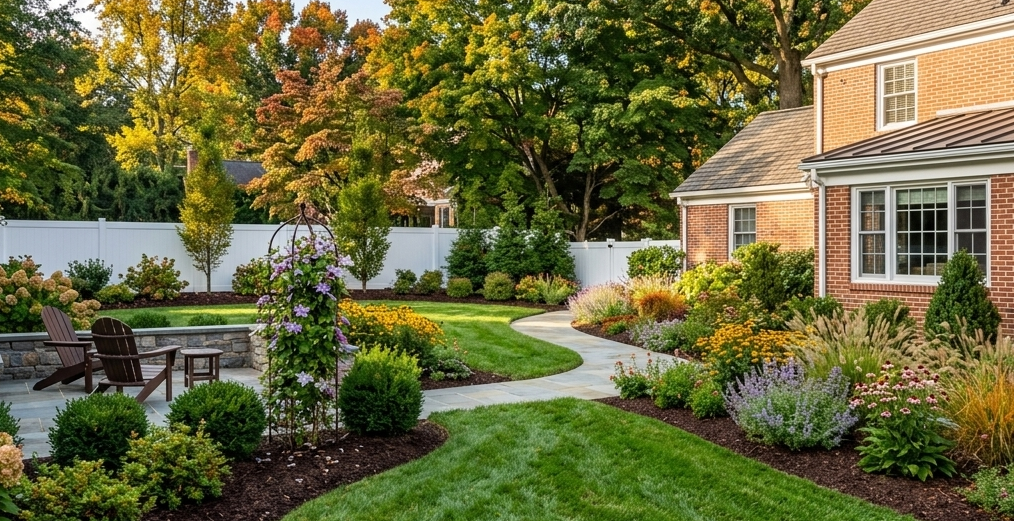
You spent $20,000 on a landscape renovation two years ago. Professional design, quality plants, new irrigation—the whole package.
Now your Japanese maples are losing their shape. Three shrubs died over winter and you’re not sure why. Mulch beds look tired by June. The irrigation controller blinks at you like it needs something, but you’re not sure what.
Here’s the thing: landscapes don’t maintain themselves. Skip spring pruning and your ornamental trees get leggy and misshapen. Miss fall aeration in our clay soil and your lawn thins out next year. Forget to winterize your irrigation system and you’re looking at $2,000+ in burst pipe repairs come March. Most homeowners in Harford County wing it—doing tasks at random times or skipping them entirely—until a $500 problem becomes a $5,000 replacement project.
Why Harford County’s Climate Demands a Specific Maintenance Schedule
Harford County sits in USDA Zone 7a with clay-heavy soil, hot humid summers, and brutal freeze-thaw cycles—your maintenance calendar needs to match these specific conditions, not some generic national blog advice.
Our last frost date hits mid-April. First frost arrives mid-October. That’s your planting window, and it’s narrower than areas 30 miles south of us.
The clay soil most properties sit on compacts like concrete without regular aeration. Water either runs off or puddles—there’s not much middle ground. This isn’t the loamy soil you read about in gardening magazines.
Our pest and disease pressures are specific too. Japanese beetles show up like clockwork in late June. Winter moth caterpillars attack in March. The humid summers we get? Perfect for fungal diseases that don’t bother landscapes in drier climates.
Generic “spring cleanup” advice doesn’t account for our weather patterns. We see ice storms in January that snap branches. Late spring frosts in early May that kill new growth. Drought conditions in September when everyone assumes fall means rain.
Properties in northern Harford County near the Pennsylvania line run about a week behind southern areas near the water. That matters when you’re timing pruning or planting.
The maintenance calendar that works here doesn’t match what works in Baltimore County, and definitely not what works in Montgomery County. Our area has specific needs.
Spring Landscape Maintenance (March-May)
Spring maintenance in Harford County is about repairing winter damage, preparing soil, and timing pruning before plants break dormancy—mess this up and you’ll spend all summer playing catch-up.
Early Spring (March)
Walk your entire property first thing in March, before you do anything else.
Look for winter damage: plants heaved out of the ground by freeze-thaw cycles, broken branches from ice storms, cracked irrigation lines. Our freeze-thaw pattern is particularly brutal on newer plantings—anything installed in the last two years is vulnerable.
March is dormant pruning time for most trees and shrubs. The sap hasn’t started running yet, and you can see the branch structure clearly without leaves in the way. This is when we prune ornamental trees like Japanese maples, crabapples, and most shade trees.
Don’t touch spring-flowering shrubs yet—forsythia, azaleas, rhododendrons. They set their flower buds last fall. Prune them now and you cut off all the spring blooms.
Start lawn prep by pulling a soil sample. You need to know your pH and nutrient levels before you dump fertilizer on your lawn. Most Harford County properties have adequate phosphorus already—adding more just runs off into the Chesapeake watershed.
Clean out landscape beds—remove winter debris and cut back dead perennial stems. But don’t mulch yet. Soil temperature matters, and early March soil is still cold. Mulching too early keeps soil cold longer and delays spring growth.
Common spring mistake we see constantly: Homeowners cutting back ornamental grasses in October or November. Leave them standing for winter interest and wildlife habitat. Cut them back in early March before new growth emerges from the center. You’ll see the difference immediately.
Mid-Spring (April)
Irrigation system start-up happens in April, once frost risk passes.
Here’s what breaks over winter: cracked PVC from freezing, broken sprinkler heads from plows or foot traffic, valves that won’t open, controllers with dead batteries. Running your system without inspection means you’re either flooding areas or missing them entirely.
Start mowing when grass reaches 3-4 inches, not based on a calendar date. Some years that’s early April. Some years it’s late April. The grass tells you when it’s ready.
Set your mower to 3 inches minimum. First mow of the season shouldn’t scalp the lawn down to dirt. You’re removing about one-third of the blade height, maximum. Scalping weakens grass and invites weeds.
Now you can mulch. Two to three inches of fresh hardwood mulch in beds. Not six inches. Not piled up against tree trunks in “mulch volcanoes” that keep bark wet and rot the cambium layer.
We pull out dozens of dead trees every year that were killed by mulch volcanoes. The homeowner or previous landscape company piled mulch 8 inches high around the trunk. Bark stayed wet. Rodents nested in it. Insects burrowed in. Tree died slowly over 3-4 years.
Pre-emergent herbicide goes down in mid-April for crabgrass prevention. You’re targeting soil temperature, not air temperature. Crabgrass germinates when soil hits 55°F for several consecutive days. In Harford County, that’s typically mid-to-late April.
Fertilize your lawn based on soil test results, not based on whatever’s on sale at the big box store. Our heavy clay soils tend to be adequate in phosphorus but need nitrogen. A slow-release fertilizer with a 3-1-2 or 4-1-2 ratio usually works well here.
Late Spring (May)
Wait until after May 15 to plant annuals. Yes, you’ll see them at garden centers in early May. Yes, it’s tempting. We still get frosts in early May some years, and one cold night kills all those impatiens and petunias you just planted.
Monitor your irrigation system as temperatures rise. What was adequate watering in April isn’t enough by late May. Walk your property weekly and look for dry spots or areas that aren’t getting coverage.
Edge bed lines and redefine borders. Grass creeps into beds over winter. Clean edges make everything look maintained.
Start pest monitoring in May. Azalea lace bugs show up on the undersides of azalea leaves—look for stippling on top of leaves and dark spots underneath. Bagworms start small and grow fast through summer if you don’t catch them early.
Now you can prune spring-flowering shrubs—forsythia, azaleas, lilacs—right after they finish blooming. Prune them in fall or winter and you remove all the flower buds. Prune them in late summer and they don’t have time to set new buds for next spring.
Pro tip we share with every client: Don’t deadhead your spring bulbs down to the ground. Remove the spent flower, but leave the foliage until it yellows naturally. Those leaves are recharging the bulb for next year’s blooms.
Summer Landscape Maintenance (June-August)
Summer maintenance is about water management, pest control, and protecting your investment during Harford County’s hottest, most stressful months for plants.
Early Summer (June)
Irrigation monitoring becomes critical in June as temperatures climb into the 80s regularly.
Most established landscapes need 1 to 1.5 inches of water weekly, including rainfall. Put out a tuna can under your sprinkler and run the system. Time how long it takes to fill it with one inch of water. That’s your baseline for weekly watering.
Deep, infrequent watering beats shallow, frequent watering every time. You’re training roots to grow deep, where soil stays moist longer. Shallow daily watering trains roots to stay near the surface, where they’re vulnerable to heat stress and drought.
Deadhead perennials after they bloom to encourage more flowers. Coneflowers, black-eyed Susans, salvia—remove spent blooms and you’ll get another flush of flowers in late summer.
Check mulch depth in beds. It should still be 2-3 inches deep. Mulch breaks down, especially in our humid climate. Add more if it’s gotten thin.
Japanese beetles arrive in late June like clockwork. You’ll see them on roses first, then on anything else they find appetizing—crabapples, lindens, grapes. Hand-picking works for small numbers. Larger infestations need treatment.
Raise your mowing height to 3-3.5 inches for summer. Taller grass shades soil, reduces water evaporation, grows deeper roots, and outcompetes weeds. Don’t scalp your lawn in summer heat.
Mid-Summer (July-August)
Water deeply but less frequently in July and August. Twice weekly deep watering beats daily light watering.
Watch for heat stress signs: wilting that doesn’t recover overnight, leaf scorch on broad-leaf evergreens, browning on hydrangeas. These tell you either the plant needs water or it’s planted in the wrong location for our climate.
Stop fertilizing grass in summer heat. Fertilizer plus heat stress equals burned, damaged turf. Your lawn’s natural growth slows in July—don’t push it with fertilizer.
Our humid summers create perfect conditions for fungal diseases. Black spot on roses. Powdery mildew on bee balm and lilacs. Brown patch in lawns. Catching these early makes treatment easier and more effective.
Afternoon thunderstorms roll through regularly in July and August. They’re intense—2 inches in 30 minutes isn’t unusual. Check irrigation heads after storms for damage from heavy rain or debris.
Keep up with weeding. Weeds that go to seed now create problems for years. Pull them or spot-treat with herbicide before they flower.
Watering mistake we see constantly: Homeowners running sprinklers for 10 minutes every evening. You’re barely wetting the surface. Roots stay shallow chasing that daily drink. Water deeply 2-3 times weekly instead—45 minutes to an hour per zone.
Fall Landscape Maintenance (September-November)
Fall maintenance sets up your landscape for winter survival and strong spring growth—skip these tasks and you’ll pay for it with dead plants and thin turf next year.
Early Fall (September)
September is the single best time to renovate lawns in Harford County. Soil temperature is still warm for quick germination. Air temperature is cooling down so seedlings don’t stress. Weed pressure is lower than spring.
Aeration breaks up our compacted clay soil and allows water, air, and nutrients to reach roots. Overseeding fills in thin areas and introduces newer, improved grass varieties.
We aerate and overseed lawns every September. The difference between lawns that get this treatment and lawns that don’t becomes obvious by the following June.
Fall fertilization feeds grass roots as they grow actively in fall and early winter. You’re not pushing top growth—you’re building strong root systems. Use a fertilizer with higher potassium content than your spring application. Potassium improves winter hardiness and disease resistance.
September and October are the best planting months for trees and shrubs in our area. Soil is warm so roots grow actively. Air is cool so tops don’t stress from heat. Plants get fall and early spring to establish before next summer’s heat arrives.
Divide perennials in September. Hostas, daylilies, ornamental grasses, coneflowers—dig them up, split the clumps, replant divisions. They’ll establish before winter and bloom better next year.
Keep watering through September. Fall drought is common in Harford County. Everyone assumes fall means rain, but we regularly go weeks without meaningful precipitation in September and early October.
Mid-Fall (October)
Leaf management starts in October and runs through November depending on your tree canopy.
Don’t let leaves smother your grass. A thin layer you can see grass through is fine—mow over it and the chopped leaves add organic matter. A thick mat that covers grass completely needs to be removed or you’ll have dead patches and disease come spring.
We removed leaves from a property in Bel Air last October. The owner had “let them sit all winter for wildlife habitat.” Underneath, we found 30% of the lawn was dead from lack of light and air circulation, plus snow mold fungus throughout.
Prepare your irrigation system for shutdown in October. We start winterizations in mid-October and finish by early November. You need to blow compressed air through the lines to remove water before the first hard freeze hits.
Plant spring bulbs—tulips, daffodils, crocuses—in October. They need cold period to bloom. Get them in the ground 6-8 weeks before the ground freezes hard.
Final mowing happens in late October or early November. Don’t scalp the lawn going into winter. Leave grass at 2.5-3 inches. Too short and you expose crowns to winter desiccation. Too tall and snow mold can develop.
Prune dead, damaged, or diseased wood any time you see it. Save major structural pruning for late winter when plants are fully dormant.
Late Fall (November)
Irrigation winterization must happen before the first hard freeze. In Harford County, that’s typically mid-to-late November, but we’ve seen hard freezes as early as first week of November.
An irrigation winterization costs $150-300 depending on system size. Replacing burst PVC lines costs $2,000-4,000. We see burst lines every spring on properties where owners “forgot” or “thought it would be fine.”
Last November we winterized 187 irrigation systems. Three clients called us in December asking to schedule winterization. All three had cracked lines when we opened their systems in April.
Final leaf cleanup happens in November. Get them off the lawn completely. Leave them in wooded areas or compost them.
Protect sensitive plants from winter damage. Burlap screens around broadleaf evergreens (rhododendrons, hollies) prevent wind desiccation. Anti-desiccant spray adds a protective coating that reduces moisture loss through leaves.
Cut back perennials or leave them for winter interest—your choice. We typically leave ornamental grasses, coneflowers, and black-eyed Susans standing. The seed heads feed birds through winter and the stems protect plant crowns from frost heave.
Drain and store garden hoses. Shut off and drain outdoor spigots. One freeze with water in the line cracks the pipe inside your wall.
Why we don’t cut back perennials in fall: Seed heads feed goldfinches and other birds through winter. Hollow stems provide habitat for beneficial insects. The structure protects plant crowns from freeze-thaw heaving. We cut everything back in early March before new growth emerges.
Winter Landscape Maintenance (December-February)
Winter isn’t maintenance downtime—this is planning season, plus critical tasks that prevent spring disasters.
What Actually Needs Doing in Winter
Monitor for snow and ice damage after winter storms. Heavy wet snow bends evergreen branches down and snaps them. Knock snow off before it freezes and adds weight.
Ice storms are our biggest winter threat in Harford County—more damaging than snowstorms. Ice accumulation snaps branches and splits trees. After the January 2024 ice storm, we removed 60+ broken limbs before they fell on houses, cars, and power lines.
Check tree stakes and supports after storms, especially on trees planted within the last two years. Stakes shift or break. Ties cut into bark as trees grow. Adjust or remove them as needed.
Dormant pruning for specific species happens in late winter (February). Fruit trees, roses, crape myrtles, most shade trees—prune them when they’re fully dormant, before sap starts flowing in spring.
Apply anti-desiccant spray to broadleaf evergreens (hollies, boxwoods, rhododendrons) in December or January. Our winter winds are drying, especially on exposed sites. The spray reduces moisture loss through leaves and prevents winter browning.
Watch for salt damage near walkways and driveways. Road salt kills foundation plantings slowly. We see dead boxwoods and hollies every spring along Route 1 properties where salt spray and runoff accumulate.
Consider alternatives to salt: sand for traction, calcium chloride (less damaging than sodium chloride), or plant salt-tolerant species in high-exposure areas.
Winter Planning
Walk your property in January or February and evaluate what worked and what didn’t work last year.
That hydrangea that browned out in July—wrong location? Not enough water? Too much afternoon sun? Make notes and plan corrections for spring.
The drainage problem at the bottom of the driveway that pools water—that needs grading work before spring rains start.
Areas where plants died or declined—you need replacements, and you need to figure out why they failed before you plant the same thing again.
Schedule your spring maintenance consultation in winter. Good landscape companies book up by March. By the time you’re ready for spring cleanup, their crews are already committed for weeks out.
Order unusual plants in winter if you’re planning spring installation. Native plants, specific cultivars, large specimen sizes—don’t wait until May when inventory is picked over.
Budget for spring projects now while you’re thinking clearly, not in April when you’re itching to get outside and make impulsive decisions. If you’re not sure where to start, take a look at our landscape maintenance services and schedule a consultation.
Professional Maintenance vs. DIY: What Makes Sense for Harford County Properties
You can handle some landscape tasks yourself, but professional maintenance prevents expensive mistakes and catches small problems before they become full replacements—here’s how to decide what to outsource.
What Most Homeowners Can Handle
Basic weeding and deadheading don’t require specialized knowledge or equipment. Pull weeds when they’re small. Remove spent flowers from annuals and perennials. You can do this during your morning coffee walk-around.
Monitoring for obvious problems is something you should do regardless of whether you have professional maintenance. Walk your property weekly. Look for wilting, discoloration, broken irrigation heads, pest damage. Catching issues early makes them easier and cheaper to fix.
Light pruning of annuals and perennials is straightforward. Cut back leggy growth. Remove dead or damaged stems. You can’t really hurt herbaceous plants with pruning mistakes—they grow back.
Adjusting your irrigation controller for weather makes a huge difference in water efficiency. Turn it down when we get a week of rain. Turn it up during drought. Most controllers are simpler than they look.
Leaf management is doable if you have time and equipment—a good mower to mulch thin layers, a blower or rake for heavier accumulation, somewhere to compost or dispose of them.
What Pays to Hire Professionals For
Irrigation system start-up, monitoring, and winterization requires specialized equipment and knowledge. You need an air compressor powerful enough to blow lines clear. You need to know the difference between drip systems and spray systems, how to adjust heads, how to troubleshoot controller problems.
We see DIY irrigation repairs regularly. Wrong fittings. PVC glued incorrectly. Controllers programmed to run all zones simultaneously. One property in Fallston had five broken spray heads that ran all summer—the owner never walked the zones while they were running. Water bill was $300 higher than necessary.
Tree pruning requires safety equipment and proper technique. Climbing ladders with chainsaws is how homeowners end up in emergency rooms. Topping trees destroys their structure permanently. Pruning at wrong times stresses trees or removes flower buds.
Soil testing and fertilization programs aren’t intuitive. Soil chemistry matters. Our heavy clay soil behaves differently than sandy or loamy soil. pH affects nutrient availability. Over-fertilizing causes as many problems as under-fertilizing.
Pest and disease diagnosis and treatment requires identifying the problem correctly first. We see homeowners treating fungal diseases with insecticides and insect damage with fungicides. Wrong diagnosis means wasted money and the problem gets worse.
Aeration and overseeding equipment rental often costs more than hiring it out, plus you’re spending your entire Saturday wrestling machines. A professional crew does it in a few hours with commercial-grade equipment.
Grading and drainage issues affect your foundation and basement. Small problems become big problems. This isn’t DIY territory unless you’re experienced with excavation and stormwater management.
The Math on Professional Maintenance
A half-acre property with moderate landscaping typically runs $400-700 monthly for full-service maintenance during growing season (April-October). That includes weekly mowing, bed maintenance, monitoring, seasonal tasks, and irrigation management.
Year-round maintenance contracts that include spring and fall cleanup, leaf removal, irrigation winterization, and winter monitoring run $6,000-10,000 annually depending on property size and landscape complexity.
What you get: scheduled visits, trained crew, commercial equipment, proper timing on seasonal tasks, early problem detection, warranty on work.
What you avoid: dead plants from neglect, failed irrigation repairs, safety incidents, wasted weekends fighting equipment or fixing mistakes.
Common Landscape Maintenance Mistakes We See in Harford County
These mistakes cost Harford County homeowners thousands every year—most are timing issues or well-intentioned but incorrect techniques.
1. Mulch volcanoes around trees
We see this on probably 40% of residential properties we visit for the first time. Mulch piled 6-8 inches high against tree trunks, sometimes covering the trunk flare entirely.
Why people do it: It looks tidy. They think more mulch is better mulch. The previous landscape company did it that way so it must be right.
What actually happens: Bark stays constantly wet. Fungal diseases and insects attack the cambium layer. Rodents nest in the mulch pile and chew bark. The tree dies slowly over 3-5 years. You don’t realize the mulch killed it until it’s too late to save.
The fix: Pull mulch back 3-6 inches from the trunk. You should see the trunk flare where it meets the ground. Maintain 2-3 inches of mulch maximum, and never touching the bark.
2. Scalping lawns in spring
The first mow of the season shouldn’t cut grass down to dirt. But homeowners get eager, or they think shorter grass means less frequent mowing.
What actually happens: You remove too much leaf blade at once. The grass stresses. Weed seeds that were shaded out suddenly get sunlight and germinate. The lawn looks worse, not better.
The fix: Remove one-third of blade height maximum on any single mowing. First mow should leave grass 3 inches tall minimum.
3. Pruning at wrong times
This is probably the single most common pruning mistake—homeowners pruning spring-flowering shrubs (forsythia, lilacs, azaleas) in fall or winter because that’s when they have time.
What actually happens: Those shrubs set their flower buds in summer and fall for next spring’s bloom. Prune them in October and you’re cutting off all the flowers. The shrub is healthy, but it won’t bloom next spring.
The fix: Prune spring-flowering shrubs immediately after they finish blooming. Prune summer-flowering shrubs in late winter or early spring before growth starts.
4. Ignoring irrigation all season
Set it and forget it works for crockpots, not irrigation systems. Broken heads, misaligned spray patterns, leaking valves—these develop over the season.
We find broken heads on probably 70% of systems we inspect mid-season. They break from lawn mowers, foot traffic, vehicle traffic. They drift out of alignment. One head fails and that entire area doesn’t get water while the homeowner wonders why plants are stressed.
The fix: Walk your irrigation zones while they’re running at least monthly. Look for broken heads, misdirected spray, dry spots, flooded spots. Catch problems early before plants suffer.
5. Fertilizing without soil testing
Guessing at fertilizer needs wastes money and often makes problems worse. Our Harford County clay soil is typically adequate or high in phosphorus. Adding more phosphorus when you don’t need it just runs off into waterways.
Many properties are also high pH (alkaline), which locks up certain nutrients even when they’re present in soil. Adding more nutrients doesn’t fix a pH problem.
The fix: Pull a soil sample every 2-3 years. Send it to University of Maryland. Follow their fertilizer recommendations based on actual test results. Costs $20 and saves you from throwing money at the wrong problems.
6. Letting leaves smother grass in fall
“Leaves are natural, they’re good for the lawn” is true in thin layers. Not true in thick mats.
We see dead patches every spring under areas where leaves sat all fall and winter. The grass underneath gets no light, no air circulation. Snow mold fungus develops. By spring, you’ve got bare spots and disease.
The fix: Remove heavy leaf accumulation from lawn areas. Compost them, use them as mulch in wooded areas, or have them hauled away. Light layers that you can see grass through can be mowed over and left.
7. Skipping irrigation winterization
This is the most expensive mistake on this list. Water left in irrigation lines freezes. Ice expands. PVC cracks. Come spring, you turn the system on and water shoots out of cracked pipes underground.
Why people skip it: They forget. They think their system will be fine. They want to save $200 on winterization.
What actually happens: Cracked lines require excavation and replacement. Minimum repair is usually $800-1,000. Extensive damage runs $2,000-4,000. We repair failed winterizations every April and May.
The fix: Winterize before the first hard freeze, typically by mid-November in Harford County. Every single year, no exceptions.
8. Over-watering or under-watering
Most homeowners over-water—frequent shallow watering that trains roots to stay at the surface. Some under-water, running irrigation once weekly for 15 minutes and wondering why plants stress.
Both create problems. Over-watering encourages shallow roots, wastes water, promotes fungal diseases. Under-watering stresses plants and makes them vulnerable to pests and diseases.
The fix: Water deeply but infrequently. Most established landscapes need 1-1.5 inches weekly total including rainfall. Run zones long enough to soak 6-8 inches deep (usually 45-60 minutes for spray heads, longer for rotors). Do this 2-3 times weekly maximum.
9. Planting in summer heat
Garden centers sell plants all summer, so homeowners assume summer planting is fine. It’s not fine, especially in our climate with July and August temperatures in the 90s.
New plants haven’t established root systems yet. They can’t handle heat stress. Mortality rate for summer planting is high even with careful watering.
The fix: Plant in spring (April-May) or fall (September-October) when soil is warm but air temperatures are moderate. If you must plant in summer, choose the toughest plants and water religiously.
10. Ignoring early pest and disease signs
Japanese beetles on one rose bush? Catch them now and you can control them. Ignore them for two weeks and they’re on ten plants and calling in reinforcements.
Bagworms start tiny in May. By August they’re 2 inches long and defoliating whole arborvitaes. Early detection makes treatment cheaper and more effective.
The fix: Walk your property weekly during growing season. Look at plants, not just past them. Catch problems when they’re small.
What to Expect from Professional Landscape Maintenance in Harford County
Professional maintenance isn’t just “mow and blow”—here’s what a real program includes and how to evaluate companies.
Components of a Complete Maintenance Program
Scheduled visits are the foundation. Weekly during peak growing season (May-September) for lawn mowing and bed checks. Bi-weekly or monthly visits might work for properties with less lawn area or lower maintenance landscapes.
Lawn care includes mowing, edging, string trimming around obstacles, debris cleanup. Proper mowing height for season. Sharp blades that cut grass cleanly instead of tearing it. Clippings either bagged or mulched depending on conditions.
Fertilization and weed control programs run separately from mowing visits. Four to six applications annually at proper timing for our climate. Pre-emergent in spring for crabgrass prevention. Post-emergent for existing weeds. Proper fertilizer ratios based on season and soil conditions.
Bed maintenance includes weeding, mulching, deadheading spent flowers, light pruning of perennials and annuals. The crew should recognize weeds versus desirable plants (sounds obvious, but we’ve seen companies pull out hostas thinking they were weeds).
Irrigation management means checking the system regularly, making adjustments for weather and plant needs, repairing broken components promptly, seasonal start-up in spring, and winterization before freeze.
Seasonal tasks include spring cleanup (removing winter debris, cutting back perennials, bed prep), fall cleanup (leaf removal, final mowing, bed prep for winter), aeration and overseeding, and seasonal pruning at proper times.
Monitoring and reporting catches problems early. The crew should notice stressed plants, pest damage, disease symptoms, irrigation issues, drainage problems. Good companies communicate what they’re seeing and recommend solutions before small problems become expensive.
How to Evaluate Maintenance Companies
Ask if they’re licensed and insured. Maryland requires licenses for lawn care companies applying fertilizers and pesticides. General liability and workers comp insurance protects you if someone gets hurt on your property.
Ask about crew training. Who’s operating the equipment? Do they know why they’re doing tasks at specific times, or are they just following a generic checklist? Can they identify common landscape problems?
Ask what equipment they use. Commercial-grade mowers and equipment work better and faster than homeowner-grade. Well-maintained equipment makes a difference in cut quality and efficiency.
Ask about response time for problems. If you notice a broken irrigation head on Tuesday, when does it get fixed? Same day? Same week? Next scheduled visit? Response time tells you how they prioritize service.
Red flags to watch for: Lowest bid by a significant margin (they’re cutting corners somewhere). No insurance or won’t provide proof. Can’t explain why they do tasks at specific times (they don’t know—they’re just following a generic schedule). Poor communication or slow response to questions.
What good communication looks like: They show up when scheduled. They notify you of schedule changes in advance. They call or text when they notice problems. They send photos of issues so you can see what they’re talking about. They explain recommendations clearly without pressure.
Local knowledge matters in our business. A company that maintains 50 properties in Harford County knows our clay soil, our pest pressures, our weather patterns, our common plant problems. They know the difference between northern and southern county microclimates. They know which plants do well here and which ones struggle.
Typical Investment for Harford County Properties
Cost ranges depend on property size, landscape complexity, and services included. These are typical ranges for our area:
Half-acre properties with moderate landscaping: $400-700 monthly during growing season for full maintenance including mowing, bed care, and monitoring. $6,000-9,000 annually for year-round contracts including seasonal tasks.
One to two-acre properties with established landscapes: $700-1,200 monthly growing season. $10,000-16,000 annually for comprehensive year-round maintenance.
Larger estate properties (3+ acres): Custom pricing based on landscape complexity, lawn area, bed area, special features (water features, lighting, extensive perennial gardens).
What affects pricing: Lot size matters, but landscape complexity matters more. A half-acre with extensive planting beds and mature trees requires more time than a 2-acre property that’s mostly lawn.
Access and terrain affect pricing. Steep slopes. Areas where equipment can’t reach easily. Properties that require hand work instead of machine work.
Services included make the biggest difference. Basic mowing and trimming costs less than full-service maintenance with irrigation management, pest control, pruning, and seasonal tasks.
Monthly versus per-visit pricing: Monthly billing evens out costs over the year. Per-visit pricing means you pay more during peak season when visits are weekly, less during slow season. Both models work—choose what fits your budgeting preference.
Seasonal versus year-round contracts: Seasonal contracts (April-October typically) cover growing season maintenance only. Year-round contracts include fall leaf removal, spring and fall cleanup, irrigation winterization, winter monitoring, and early spring prep.
We maintain properties from half-acre lots in Bel Air to 5-acre estates near Street. The common thread isn’t property size—it’s homeowners who see their landscape as an investment worth protecting, not just grass to cut.
Professional Landscape Maintenance Services
Ready to create a landscape that enhances your property and reflects your vision? Our design process begins with an in-depth consultation where we discuss your goals, assess your property, and explore how we can bring your outdoor space to life.