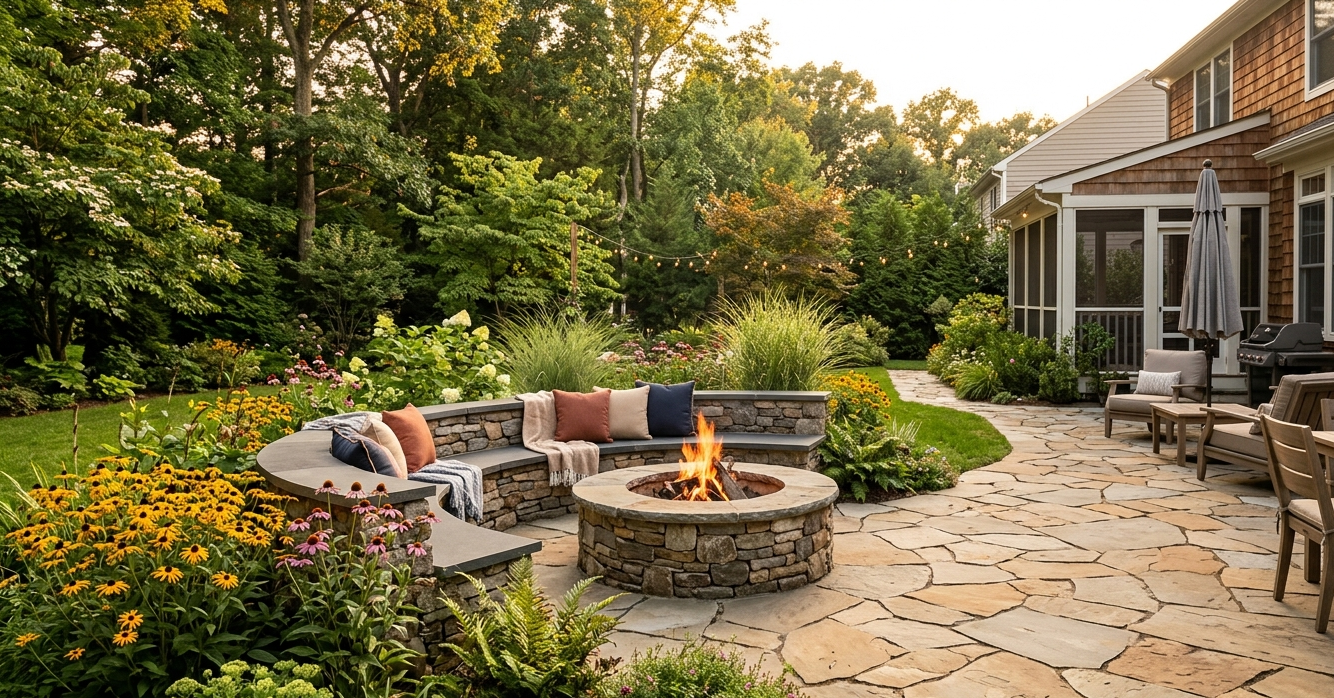
You’ve been staring at that blank slate backyard (or outdated 1990s landscaping) for three years now. You have a Pinterest board with 247 pins. You know you want a patio, maybe a fire pit, definitely better plantings. But every time you start calling around, you hit the same wall—landscape designers who hand you pretty drawings with no plan to build them, or hardscape contractors who can pour concrete but shrug when you ask about plant selection.
So you’re stuck playing general contractor yourself, trying to coordinate the patio guy, the irrigation installer, the lighting person, and the landscaper. Meanwhile, your project timeline stretches from “maybe done by summer” to “well, there’s always next year.” And nobody seems to take responsibility when the designer’s vision doesn’t match what the contractor says is actually buildable on your sloped Harford County lot.
Here’s what works better: residential landscape design and build services. One team that designs your project AND installs it. We’ve been doing this in Harford County for years, and I’ll show you exactly how the process works, what it costs, realistic timelines, and what to look for when you’re choosing who to trust with your biggest outdoor investment.
What “Design-Install” Actually Means (And Why It Matters for Your Project)
Design-install means one company handles both the design drawings and the physical installation—you work with the same team from first sketch to final cleanup.
The traditional landscape model works like this: You hire a designer who creates beautiful plans. Then you take those plans to contractors and get bids. Then you pick a contractor and hope they can actually build what the designer drew. Then you discover the designer specified a plant that’s impossible to find locally, or designed a patio that would require removing a tree you wanted to keep, or didn’t account for the water that pools in your yard every spring.
With residential landscape design and build, the designer and installation crew work for the same company. They collaborate throughout your project. When we design a natural stone patio, our installation team is already thinking about drainage solutions for your specific lot before we finalize the design. When plant selection happens, the designer knows what our crew can source and install properly.
This matters everywhere, but it especially matters in Harford County. We’ve got rolling terrain that needs careful grading. Heavy clay soil in many areas that requires specific drainage approaches. Deer that will eat your hostas down to nubs if you’re backing to farmland. A design-install team that works here regularly knows these challenges before they become expensive surprises.
The real benefit shows up when something unexpected happens during installation. Last spring, we had a client in Fallston whose original plan included a dry creek bed for drainage. During excavation, our crew discovered an underground spring that wasn’t obvious during the initial site visit. Because our designer was part of our team, he came out that afternoon, assessed the situation with the crew, and we redesigned on-site to incorporate a small recirculating water feature instead. No change orders. No delays waiting for the designer to respond. No finger-pointing about who’s responsible for the extra cost.
That’s what design landscape construction looks like when it’s done right—one team, one responsibility, one timeline.
What Design-Install Landscape Projects Actually Cost in Harford County
Most comprehensive residential design-install projects in Harford County range from $25,000 to $75,000, though smaller refreshes start around $15,000 and estate-level projects can exceed $150,000.
Let me break down what you actually get at different investment levels, with real numbers based on current material and labor costs.
Basic Patio and Simple Plantings: $15,000-$25,000
At this level, you’re typically getting:
- 300-400 square foot paver patio (concrete pavers)
- Simple fire pit or seating area
- Updated foundation plantings (15-25 plants in 2-3 gallon sizes)
- Mulched beds
- Maybe basic landscape lighting (4-6 fixtures)
This works well for homeowners who need one good outdoor living space and want to freshen up tired plantings. It’s not transforming your entire yard, but it’s creating a usable patio area and making your house look cared-for from the street.
In Harford County, at this budget level we’re usually using concrete pavers rather than natural stone, and choosing smaller plant sizes that fill in over two seasons rather than instant impact specimens.
Full Backyard Transformation: $40,000-$75,000
This is the sweet spot for many Harford County homeowners. You’re getting:
- Large patio (500-700 square feet) with quality materials
- Fire pit or fire feature with built-in seating
- Pergola or shade structure
- Complete landscape overhaul front and back (40-60 plants)
- Landscape lighting throughout (15-20 fixtures)
- Irrigation system
- Premium mulch and bed edging
- Maybe a water feature or outdoor kitchen basics
At this investment level, you’re genuinely transforming how you use your property. You’re creating multiple outdoor living spaces that flow together. You’re choosing between good options on materials—maybe natural stone for high-visibility areas and concrete pavers for secondary spaces.
Site conditions affect cost significantly in this range. If your Harford County property has slope, you might need retaining walls. A basic 3-foot-high, 20-foot-long retaining wall in natural stone adds $6,000-$10,000. If you’ve got heavy clay soil with drainage issues, addressing that properly adds cost but prevents problems down the road.
Estate or Complex Projects: $100,000+
These projects typically involve:
- Multiple outdoor living spaces (entertaining patio, quiet reading nook, pool surround)
- Large-scale grading and retaining walls to create usable space on challenging terrain
- Mature specimen plantings for immediate impact
- Water features like ponds or fountains
- Comprehensive outdoor lighting and irrigation
- Outdoor kitchens with built-in grills, refrigerators, and counters
- Driveway renovations or circular drives with elaborate plantings
You see these on larger Harford County properties (acre-plus) where homeowners are creating true outdoor estates. The complexity and material quality drive costs up significantly.
What Affects Cost Most:
Material choices make huge differences. Let’s talk patios specifically:
- Concrete pavers: $12-18 per square foot installed
- Natural stone (bluestone, limestone): $25-35 per square foot installed
- High-end pavers with complex patterns: $18-25 per square foot installed
For a 500-square-foot patio, that’s the difference between $9,000 and $17,500 just in patio surface material and installation.
Site conditions matter enormously. Sloped Harford County lots require retaining walls, extra grading, more extensive drainage work, and more labor to move materials around. A simple flat backyard project might cost $40,000. The same design on a sloped lot with a 4-foot grade change could cost $55,000 because of the additional structural work required.
Plant selection affects budget too. You can create a beautiful landscape with smaller plants (2-3 gallon sizes) for $4,000 in materials. Or you can use larger specimens (7-15 gallon sizes) and mature trees for instant impact at $12,000 in materials. Both approaches work—it depends on whether you want immediate wow factor or you’re willing to wait two seasons for plants to fill in.
What’s Usually NOT Included:
To avoid surprises, here’s what most landscape design-install companies don’t handle:
- Major tree removal (anything over 12 inches diameter usually needs a dedicated tree service)
- Pool construction (though we do surrounds, decking, and plantings around pools)
- Fence installation (some companies do this, many don’t)
- Well work if you need irrigation connected to existing well (may need separate well contractor)
- Major electrical service upgrades (we handle landscape lighting, but if your panel needs upgrading for an outdoor kitchen, that’s an electrician)
Always clarify what’s included in your quote. Reputable companies are explicit about scope.
Design Fees in the Design-Install Model:
Here’s a cost advantage of the design-install approach: design fees are typically rolled into the overall project cost rather than charged separately upfront.
If you hire an independent landscape designer, you might pay $2,000-$5,000 just for plans. Then you take those plans to contractors for bids. Then those contractors add markup because they’re pricing someone else’s design (and dealing with any questions or issues that arise from plans they didn’t create).
With design-install, the design work is built into your project pricing. You’re not paying separately for plans. The value trade-off: you’re committing to one company for both design and installation rather than shopping the design around for the lowest installation bid.
Most homeowners find this worthwhile because the design stays realistic—we’re designing what we know we can build well, within your stated budget, on your specific property conditions.
Design-Install vs. Hiring Separately: The Real Difference
Hiring separate designer and contractor typically costs 15-25% more and adds 4-8 weeks to your timeline, plus you become the project manager.
Let me show you what this looks like in practice.
The Design-Install Advantage:
Single point of accountability is huge. When something goes wrong or needs adjusting, you call one company. You’re not stuck in the middle while the designer and contractor argue about whose responsibility it is.
Design stays within buildable and budget parameters. Our designers know what materials cost right now, what our crews can install efficiently, and what works on Harford County properties. They’re not creating Pinterest-perfect concepts that are impossible to execute at your budget.
Timeline stays streamlined. We move from design approval to installation immediately because we’re not waiting for you to get contractor bids, evaluate options, and make selections. Most design-install projects go from first meeting to completion in 8-12 weeks total.
No markup games. When a contractor prices out someone else’s design, they often add markup for the risk of dealing with plans they didn’t create. With design-install, there’s no adversarial relationship between designer and builder—we’re the same team with the same goal.
Real-time problem solving changes everything. Last summer, we were installing a patio in Bel Air when we discovered the “lawn” area the client wanted to keep was actually mostly crabgrass and would look terrible next to new plantings. Our designer was on site that afternoon. We adjusted the planting bed sizes to eliminate that section and added more interesting plants with the slight budget shift. The client was thrilled. The whole adjustment took two hours and zero finger-pointing.
When Hiring Separately Might Make Sense:
I’ll be honest about when the traditional approach works better.
Highly complex projects that need a licensed landscape architect might require separate design work. In Maryland, landscape architects handle large commercial projects, complicated grading and stormwater plans, and projects with significant regulatory requirements. Most residential work doesn’t reach that threshold, but if you’re doing major land development, you might need that level of expertise.
Historic properties with special requirements sometimes benefit from specialized designers who focus on period-appropriate landscapes. If you’ve got a 1790s stone farmhouse in Harford County and want historically accurate plantings, that’s a niche expertise.
If you have an existing relationship with a contractor you trust completely but they don’t offer design services, bringing in design help can work. The key is making sure everyone communicates well from the start.
Phased projects where design happens years before build might need separate design. If you’re planning a master plan for your property but only building phase one now, an upfront comprehensive design might make sense. But honestly, most homeowners who think they want this end up building sooner than planned once they see the design.
The Hidden Costs of Separate Hiring:
Your time becomes a project cost. You’re coordinating meetings between designer and contractor. You’re managing change orders when field conditions don’t match the design. You’re tracking down answers when the contractor has questions about the designer’s intent. You’re becoming an unpaid project manager.
Communication gaps cost money. The contractor doesn’t understand why the designer specified a particular material. The designer didn’t know about the underground utility the contractor discovered. These gaps lead to delays, change orders, and frustration.
Warranty confusion causes headaches. When plants don’t thrive, is it because the designer chose poorly for the conditions, or because the contractor didn’t install properly, or because the soil prep wasn’t adequate? Good luck figuring out who’s responsible.
Choosing the Right Design-Install Team: 8 Questions to Ask
The right questions reveal whether a company has real experience with projects like yours and a process that protects your investment.
Don’t just call and ask “how much for a patio?” Here’s what you should ask during initial conversations with landscape design and build companies:
1. “How many design-install projects have you completed in the last two years?”
Listen for specific numbers, not vague “lots” or “many years of experience.” A company actively working in this model should complete 15-30 full design-install projects annually (depending on company size).
Red flag: Companies that do mostly design-only or installation-only work and are just starting to offer combined services. You don’t want to be their learning curve.
Good answer sounds like: “We completed 23 full residential design-install projects last year, ranging from $18,000 to $140,000, mostly in Harford and Baltimore Counties.”
2. “Can I see three examples of projects similar to mine in scope and budget?”
They should have a readily available portfolio with before-and-after photos, project details, and ideally some context about challenges and solutions.
Red flag: They only show you high-end estate work when your budget is $30,000, or they don’t have projects similar to what you’re envisioning. That means either they don’t work at your level or they’re stretching to show you anything.
Good answer includes: Photos from multiple angles, explanation of what the client wanted to achieve, specific details about materials and plantings, and honest discussion of what was challenging about the project.
3. “Who will I be working with throughout the project?”
You want named individuals with clear roles, not “you’ll work with whoever’s available.”
Listen for: “Sarah will be your designer and primary contact through design approval. Then Mike, our installation project manager, takes over during construction. Sarah checks in at key milestones to make sure the installation matches her design intent. I [the person you’re talking to] stay involved throughout.”
Red flag: Vague answers about “our team” or companies where you never know who’s going to show up or respond to calls.
4. “What’s your process if something unexpected comes up during installation?”
Every project has something unexpected—a utility line that’s not where records showed, rock under the soil, drainage that’s worse than initial assessment suggested. You want a clear communication protocol.
Good answer: “We contact you the same day, explain what we found and what it means, provide options with costs for addressing it, and get your written approval before proceeding. Small adjustments under $300 we handle and document. Anything larger gets a formal change order you sign.”
Red flag: Casual attitude like “we just figure it out” without clear communication or pricing process. That’s how surprise bills happen.
5. “How do you handle plantings that don’t survive the first season?”
Most companies offer a one-year warranty on plant material, but conditions apply. You need to know exactly what’s covered.
Good answer: “We guarantee plants for one year assuming normal weather and proper watering per our guidelines. If something dies, we replace it at no charge. If all the plants in one area die, that suggests watering or drainage issues, and we’ll investigate the cause together. We don’t warranty plants if there’s been deer damage, lawn chemical overspray, or if irrigation wasn’t used during dry periods.”
Red flag: No warranty, or the dodge answer of “plants are living things, we can’t guarantee them.” Quality companies stand behind their plant selection and installation.
6. “What do most projects like mine cost, and what’s included in that price?”
They should give you a realistic range even in an initial conversation, with major components listed.
Good answer: “For a project like you’re describing—full patio, fire pit, updated plantings—most of our clients in Harford County invest $35,000 to $55,000. That includes design, all materials, installation, cleanup, and one year warranty. It doesn’t include fence work or major tree removal if those are needed.”
Red flag: “Every project is different, impossible to estimate” without providing any ballpark. Or suspiciously low estimates that sound too good compared to other bids you’re getting—they’re likely missing something.
7. “What permits or approvals will we need, and who handles that?”
A company working regularly in Harford County should know local requirements cold.
Good answer: “Most patio and planting projects don’t require permits. If we’re building retaining walls over 4 feet or doing significant grading, we handle those permit applications with the county. If you’re in a homeowners association with landscape approval requirements, we provide the drawings and information you need to submit, though you’ll need to submit it as the homeowner. Typical permit timeline adds 2-3 weeks.”
Red flag: “You’ll need to check on that” or vague answers about regulations. This should be their everyday knowledge.
8. “What’s your typical timeline from design approval to project completion?”
You want realistic timeframes with explanation of what affects timing.
Good answer: “From the day you approve the design, we’re typically looking at 2-3 weeks to finalize materials and get you on the installation schedule. Then installation takes 4-8 weeks depending on scope and weather. So about 8-12 weeks total from design approval to final walkthrough. We’re currently booking new projects for [specific timeframe]. Projects starting in spring can be weather-dependent—we need dry conditions for good base compaction.”
Red flag: “We can start tomorrow” when it’s peak season. Good companies have a backlog because people want to work with them. Also watch for unrealistic promises about completion—they’re either overpromising or they don’t understand what can go wrong.
Harford County-Specific Considerations for Your Landscape Project
Harford County’s clay-heavy soil, active deer population, and variable terrain mean your landscape design needs to account for local conditions, not just look good on paper.
Generic landscape design fails here. Let me explain what makes Harford County different and why it matters for your project.
Soil Conditions:
Much of Harford County has heavy clay soil. If you’ve ever tried to dig a hole after rain, you know—it’s like concrete when dry, soup when wet, and sticky clay in between.
This affects your project in several ways. Clay doesn’t drain well, so patios need proper base preparation with adequate drainage or you’ll have standing water. Planting beds often need amendment with compost to improve drainage and give roots something they can actually grow through. Trees and shrubs sometimes need raised planting or mounding to keep roots from sitting in saturated soil during wet periods.
Some Harford County properties, especially in northern areas, have rocky subsoil. We’ve hit shale layers 18 inches down that make excavation slow and expensive. Good design-install companies learn this during the initial site analysis—we’ll dig test holes if we suspect rock—so it’s addressed in budgeting, not as a surprise during installation.
Wildlife Pressure:
Deer are active throughout Harford County. If your property backs to farmland, forest, or undeveloped space—especially in areas like Churchville, Pylesville, or northern Bel Air—deer are coming through your yard regularly.
This shapes plant selection fundamentally. Hostas get eaten to the ground. Tulips become deer snacks. Arborvitae get browsed to death. You can either choose deer-resistant plants from the start, or accept that you’ll need fencing or repellents, or resign yourself to replacing damaged plants regularly.
Deer-resistant options that work well here include boxwoods, fountain grass, catmint, Russian sage, daffodils, black-eyed susans, and most ferns. Nothing is completely deer-proof when they’re hungry, but these get browsed far less than alternatives.
The best design approach: assume deer are a factor unless your property is in a dense neighborhood where deer rarely venture. It’s easier to be pleasantly surprised that your hostas survived than to watch expensive plantings get destroyed.
Terrain and Grading:
Harford County isn’t flat. Many properties have rolling terrain that’s lovely to look at but challenging to create usable outdoor space on.
Slopes mean retaining walls, terracing, or creative grading to create level areas for patios and lawns. A slope that looks moderate—maybe 3 feet of elevation change across 20 feet—can make patio installation significantly more complex and expensive.
Good design-install teams evaluate this during site analysis and factor it into design and budget from the start. We’re looking at where we can tuck a patio into the slope, whether we need walls to create a level area, and how we’ll manage water runoff so it doesn’t flow toward your house.
If your property has significant slope, expect that a meaningful portion of your budget goes to the structural work that makes the site usable, not just the pretty finishing touches.
Climate Considerations:
Harford County sits in USDA plant hardiness zone 6b to 7a depending on your specific location. We get cold winters—down to -5°F in bad years—and hot, humid summers.
This means plant selection focuses on cold-hardy options that can also handle summer humidity. Trendy plants that thrive in zone 8 (like rosemary or lavender, which struggle with our cold) need to be avoided or treated as annuals. Heat-loving plants that hate humidity (like many alpine species) struggle here too.
Your best plant palette includes mid-Atlantic natives and proven performers: river birch trees, native azaleas, switchgrass, eastern red cedar, inkberry holly, Virginia sweetspire. These handle our full range of conditions without babying.
The freeze-thaw cycles we get in late winter are hard on hardscaping too. Water gets into cracks, freezes and expands, then thaws. This is why we’re careful about base preparation and why we prefer quality pavers or natural stone that handles these cycles better than cheap concrete products.
Water Considerations:
Some Harford County properties are on wells, others on municipal water. This affects irrigation planning and cost.
Municipal water means straightforward irrigation system connection with a backflow preventer. Well water requires coordination with well contractors for proper connection, and you need to verify your well capacity can handle irrigation demand on top of household use.
Many older homes in Harford County have wells that produce 5-7 gallons per minute. That’s fine for household use but marginal for running an irrigation system simultaneously. We need to design irrigation zones that don’t exceed well capacity, or you need well upgrades.
Some homeowners prefer not to irrigate at all, relying on rainfall. That’s fine—it just means choosing extremely drought-tolerant plants and accepting that lawns will go dormant and brown during dry summer stretches.
Local Regulations:
Harford County has requirements around stormwater management, grading, and setbacks. Most standard residential landscape projects don’t trigger review, but larger projects sometimes do.
If you’re near streams, wetlands, or on significant slopes, additional regulations may apply. Properties with homeowners association covenants have another layer of approval requirements—usually aesthetic review of plans before you can proceed.
A good design-install company working regularly in Harford County knows these requirements and flags them during initial consultation. We should be telling you “your property is in a Chesapeake Bay critical area, so we’ll need to follow specific planting guidelines” or “your HOA requires architectural review—here’s what we’ll need to submit.”
Common Landscape Design-Install Mistakes (And How to Avoid Them)
Most landscape project regrets come from prioritizing looks over lifestyle, under-planning for maintenance, or choosing the wrong team.
I’ve seen homeowners make the same mistakes repeatedly. Here’s how to avoid them.
Mistake 1: Designing for the Camera, Not for Your Life
The most common regret we hear: “It’s beautiful, but we never use it.”
This happens when homeowners focus on creating something that looks perfect in photos rather than thinking about how they actually live. They install elaborate perennial gardens that need 5 hours of weekly maintenance when they’re busy professionals who travel frequently. They build a huge patio but realize they prefer intimate dinner parties of six, not crowds of thirty.
The fix: Be brutally honest during design phase about your lifestyle. How much time will you genuinely spend maintaining plantings? Do you actually grill out three times a week, or is twice a month more realistic? Do you have young kids who need lawn space to play, or teens who won’t use the yard anyway? Will you be here to water plants during dry stretches?
Example from a recent project: Clients initially wanted a large cutting garden with roses, dahlias, and other high-maintenance bloomers. When we asked how much time they spend gardening now, they admitted “almost none—we’re usually at the boat on weekends.” We pivoted to a low-maintenance design with native plantings that look great with minimal input. They’re much happier with something beautiful that doesn’t make them feel guilty about neglecting it.
Mistake 2: Skimping on Drainage and Grading
The most expensive mistake is under-investing in proper drainage because it’s invisible once the project is finished.
Homeowners see the quote and think “why am I paying $3,000 for drainage when I could use that money for a bigger patio or better plants?” Then they get a beautiful patio that puddles after every rain, or planting beds where half the plants die because they’re sitting in saturated soil.
The fix: Let your design-install team address drainage properly even if it adds cost. Drainage is the foundation that makes everything else work. A patio with good base preparation and drainage lasts 20+ years. A patio built on inadequate base starts settling and creating problems within 5 years.
In Harford County specifically, with our clay soils and rolling terrain, drainage isn’t optional. We need proper grading to move water away from structures. We need adequate base depth under hardscaping. We need amended soil in planting beds so roots don’t drown.
Mistake 3: Choosing Based on Lowest Bid
A contractor comes in 30% below everyone else. Sounds great, right?
Usually it means they’re either missing something in their estimate, planning to cut corners on quality, or going to hit you with change orders that bring the price back up. Sometimes it means they’re desperate for work because they don’t get repeat business or referrals.
The fix: Choose based on value, process, and fit—not just price. Interview at least three companies. Look at their portfolios.
Maryland-based design and install services
Ready to create a landscape that enhances your property and reflects your vision? Our design process begins with an in-depth consultation where we discuss your goals, assess your property, and explore how we can bring your outdoor space to life.